

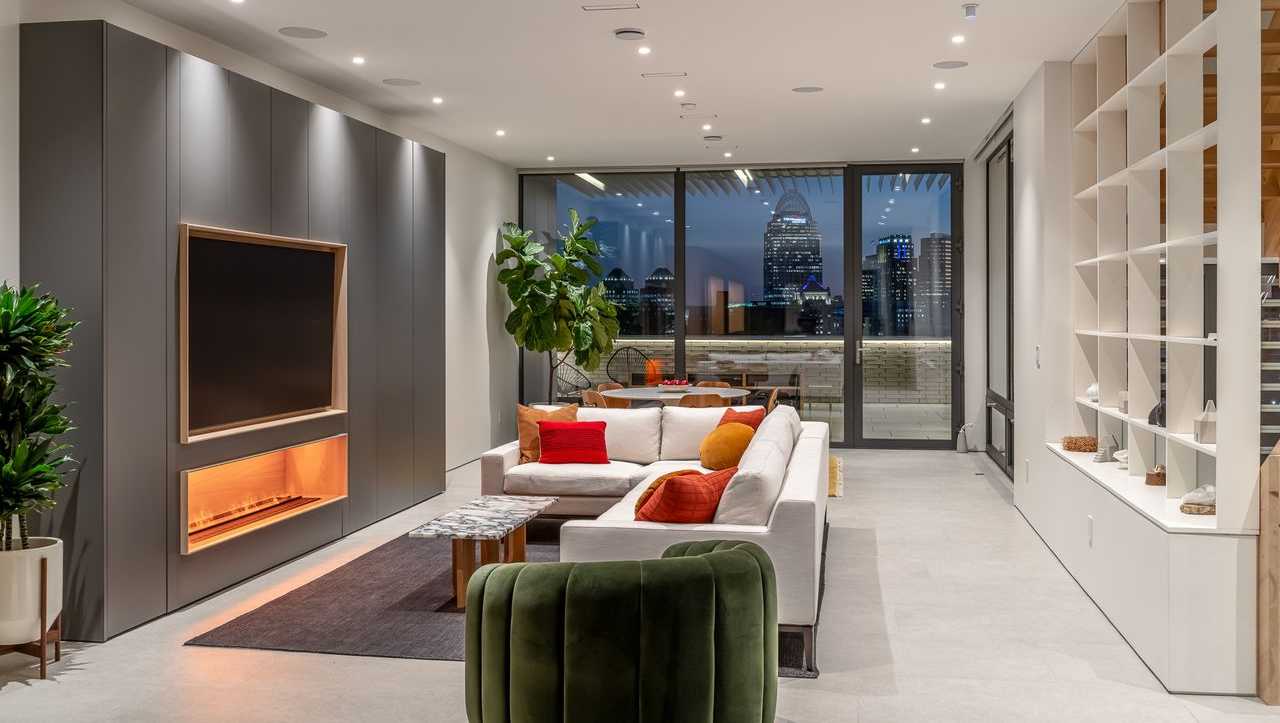
Perched above the city, this remodel was conceived as a project where architecture, light, and custom Italian cabinetry come together seamlessly. What began as a challenging hillside site ultimately became an opportunity to rethink how a home engages with its surroundings—not as a backdrop, but as an active part of the architectural experience, going on to win the 2026 AIA CRAN Awards for New Custom Contemporary Home.
For architect Michael Rogovin, this project was personal. He’d taken over this design after the passing of Terry Boling, a renowned architect for whom Rogovin had worked for as an assistant and designer for many years. Rogovin went into the project wanting not only to honor the beautiful surroundings of the home, but also the legacy of his mentor who had started the project initially and very much defined it. “When you’re working with a site like this—where the city is always present—you don’t design rooms in isolation,” Rogovin says. “You’re designing a sequence of spaces that are constantly in dialogue with the view.”
This dialogue drives the entire home. Rather than compartmentalizing functions, the design unfolds as a continuous interior landscape shaped by light, proportion, and movement.
Designing for a Hillside with Panoramic Views

For Rogovin, the topography of the site, and its elevated vantage point, set the tone for every decision that followed.
“The hillside isn’t just a condition to solve,” Rogovin explains. “It becomes the organizing principle. The way the home steps, the way it opens up, the way light moves through it—it all comes from that relationship to the city.”
Large expanses of glazing frame the skyline, but the design resists turning the home into a glass box. Instead, architecture and millwork work together to create moments of compression and release, creating spaces that feel intimate before opening outward again. This balance between enclosure and openness is what gives the home its sense of rhythm.
The Open Kitchen and Living Space as Architectural Core

At the center of the home, the kitchen and living space operate as a single, continuous environment.
“We approached the kitchen and living area as one architectural system,” Rogovin says. “Not two rooms, but one experience—where the city becomes part of the interior.”
A large central island anchors the space, while surrounding oak cabinetry extends wall to wall, concealing appliances and storage within a unified surface. The result is a room that feels calm and highly resolved, even as it supports the complexity of daily life.
“The goal was to eliminate anything that felt applied,” Rogovin notes. “Everything you see is part of the architecture—not added onto it.”
Subtle details reinforce this precision: recessed lighting, flush alignments, and continuous reveals allow the eye to move uninterrupted across the space. Secondary service areas are carefully tucked out of view, maintaining the clarity of the main volume.
Custom Italian Cabinetry as Architecture
Throughout the home, cabinetry is treated not as furniture, but as a structural element.“In a minimalist environment like this, cabinetry does the work of walls,” Rogovin explains. “It defines space, it controls proportion, and it carries the material language through the entire project.”

This approach is especially evident in the kitchen, where cabinetry integrates appliances, storage, and circulation into a cohesive architectural plane. But it continues well beyond that.
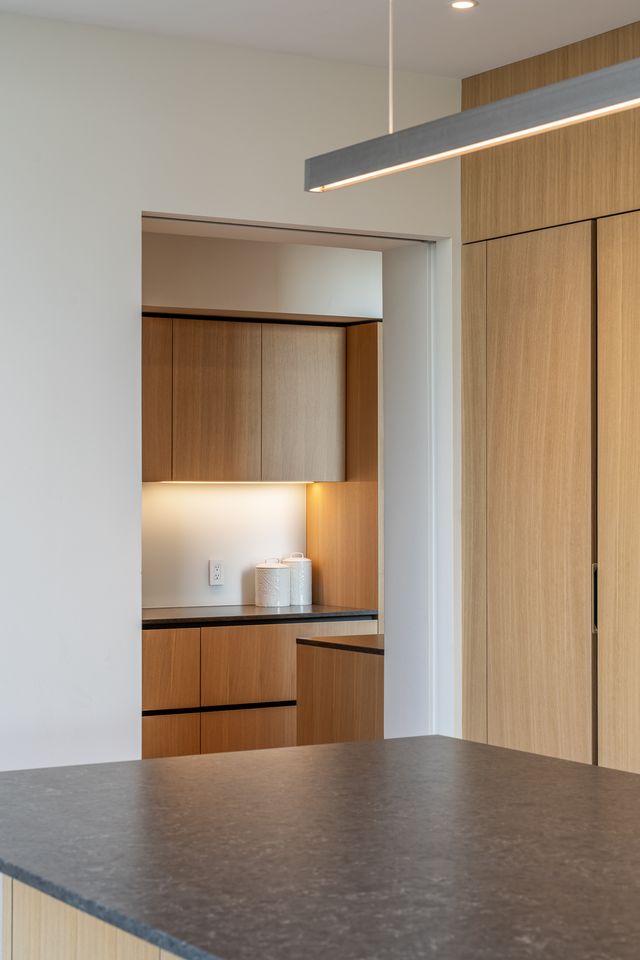
In transitional spaces, concealed storage and secondary work zones support the home’s functionality without interrupting its visual calm. “Precision is everything in a project like this,” Rogovin adds. “When lines don’t align, or materials shift unnecessarily, you feel it immediately. The success comes from that level of control.”
Continuity into Private Spaces

As the home moves into more private areas, the architectural language becomes more intimate. In the living room, darker cabinetry introduces contrast and depth, anchoring the space while framing the city beyond.

When we move to the bedroom, charcoal-toned cabinetry wraps the space, integrating storage, seating, and the bed surround into a single composition.
“We didn’t want the bedroom to feel like a collection of objects,” Rogovin says. “It needed to feel like one continuous environment.”
A built-in window bench extends the architecture horizontally, creating a quiet moment within the room while maintaining its connection to the outdoors. The introduction of color—most notably in the upholstered seating—adds warmth without disrupting the overall restraint.
Bathrooms as Extensions of the System

The same principles carry into the bathrooms, where material continuity and precision define the experience.
“Consistency is what makes a home like this feel complete,” Rogovin explains. “You can’t have one set of rules in the kitchen and another in the bath.”
Warm wood vanities, integrated lighting, and carefully proportioned surfaces create a sense of calm that feels both minimal and highly considered. Each element is treated as part of the larger architectural system rather than a standalone feature.“Custom solutions are essential here,” he adds. “Standard components don’t give you the control you need to maintain that level of alignment and continuity.”
A Collaborative Architectural Process
A project of this level requires early and close collaboration.
“NOLI was brought in early, which made a huge difference,” Rogovin says. “When cabinetry is this integrated, it has to be part of the architectural conversation from the beginning.”
That collaboration allowed the design to resolve at both the macro and micro scale—aligning elevations, materials, and sightlines with a high degree of precision.“It’s not just about fabrication,” Rogovin notes. “It’s about thinking through how every surface meets, how every line carries through. That’s where the project really comes together.”
Designing for Timelessness
For Rogovin, the success of the home ultimately comes down to restraint.
“Timelessness comes from clarity,” he says. “When you reduce a project to its essential elements—light, proportion, material—you’re not chasing trends. You’re creating something that will hold up over time.”
In this hillside residence, that clarity is evident in every space. From the open kitchen and living area to the more private, enclosed rooms, the home maintains a consistent architectural language that feels both modern and enduring. The result is not just a remodel, but a fully realized environment—one where architecture, light, and custom Italian cabinetry work together to transform a dramatic site into a refined, livable home.
To begin your own project, visit our Cincinnati showroom or connect with the team through the contact page to start the conversation.


